
Building a Victorian Gothic Room: Where to Start and What It Requires
What Victorian Gothic Actually Requires
Victorian Gothic is the most architecturally demanding of the gothic aesthetics. It draws from a specific historical moment — the British Victorian era, its mourning culture, its fascination with death as subject matter for beauty — and it requires a certain weight and density of material to read correctly. You cannot approximate it with the right color palette and a few dark accessories. The room needs to feel like it has accumulated over time.
This guide covers the actual transformation: what to establish first, what follows, and how the MAVRA pieces function within it.
Start With the Surfaces
Victorian Gothic rooms have dark, rich surfaces. Deep charcoal, burgundy, forest green, or near-black on the walls — ideally matte or with a slight texture. This is not negotiable. A Victorian Gothic room on a white or cream wall reads as costume, not conviction. The color is the foundation everything else presses against.
If repainting is not immediately possible, heavy curtains in dark velvet or dense linen pulled across most of the wall can substitute temporarily. The goal is to reduce the amount of light-colored surface visible in the room. Victorian Gothic is not about eliminating light — it's about controlling it, directing it, keeping it close.
Dark hardwood floors or dark area rugs anchor the space from below. If the floor is light and cannot be changed, a large, dark area rug — Persian patterns in deep colors, solid dark linen or wool — can do the same work.
Furniture: The Requirement for Weight
Victorian Gothic furniture is heavy. Carved dark wood — mahogany, ebony, dark walnut — with architectural lines and ornate detail. Tufted velvet upholstery in deep jewel tones or black. Pieces that look like they were made to last for generations, because Victorian Gothic is aesthetically obsessed with things that endure.
This does not mean the room needs to be filled with antiques, though genuine Victorian or Victorian-revival pieces work best. What matters is the quality of the lines and the weight of the material. A modern piece that is too lightweight or too clean in its construction breaks the atmosphere even if its color is correct.
Start with the dominant piece — the bed, the desk, or the main seating — and build outward from there. One strong piece with genuine weight is worth more than a room full of approximations.
Victorian Gothic asks more of a room than most people expect. It asks for commitment, for mass, for the willingness to let the space become heavy.
Textiles as Architecture
Victorian Gothic spaces use textiles the way other styles use furniture: as structural elements that define the shape and feel of the room. Heavy curtains that reach the floor, gathered and layered. Velvet throws and cushions. A canopy or draping over the bed if the ceiling allows it.
The function of these textiles is not decorative softness — it is acoustic and visual weight. They absorb sound, they reduce ambient light, and they change the felt dimensions of the room. A Victorian Gothic bedroom with proper drapery feels smaller and more contained than its actual dimensions. That containment is intentional and is part of the atmosphere.
Layer first, then refine. The first set of curtains does not need to be perfect. The goal is to understand how the space responds to reduced light and increased textile mass before committing to the final arrangement.
Light as the Final Layer
Victorian Gothic spaces are built around controlled, intimate light sources. The overhead light, if it exists, should be dimmable and rarely used at full brightness. The working light of the room comes from lamps and candles — sources that produce a defined pool of warm light and allow the surrounding space to remain dark.
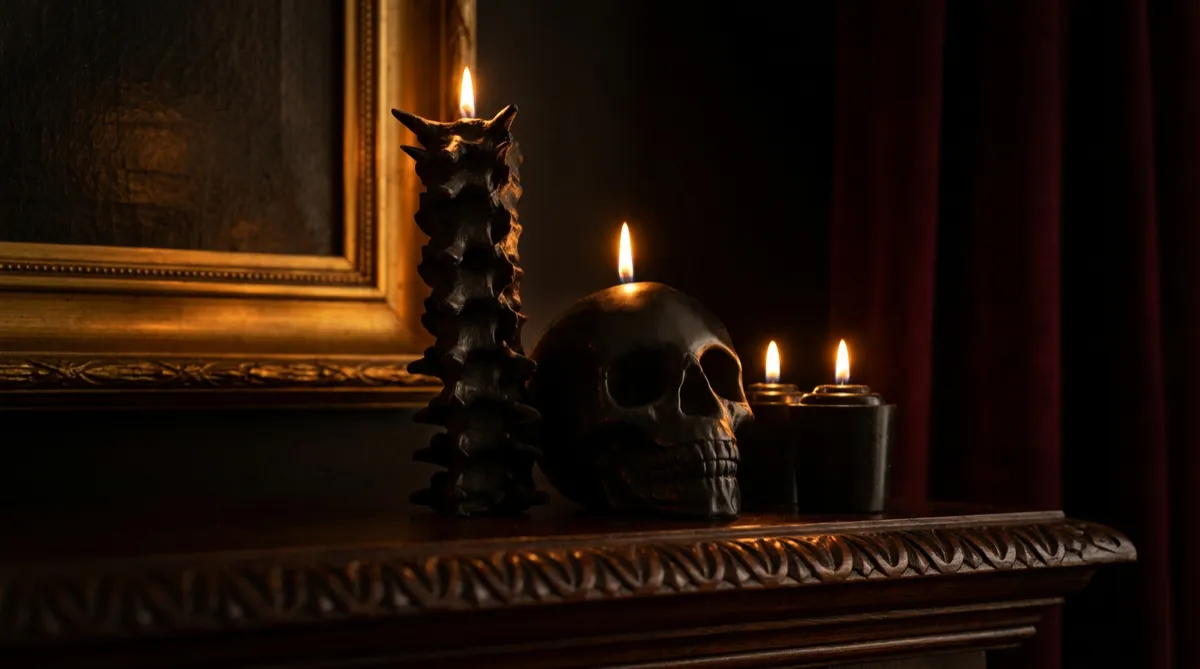
The Skull Candle Set functions in a Victorian Gothic room at a foundational level. The skulls are not ironic here — they are historically appropriate. The Victorians used skull imagery seriously, in jewelry, in art, in interior ornament, as a direct reference to mortality. A set of skull candles on a mantle or a dressing table in a Victorian Gothic room reads as period-correct, not edgy.
The warm amber light from the candles is also the correct temperature for this aesthetic. Victorian rooms were lit by flame — gas, oil, or candle — and the color temperature of those light sources is what the aesthetic grew from. Electric light that approximates this warmth (2700K or lower) is the right choice for anything that does not run on candles.
Adding the Wall Decor
The Skull Wall Decor fits Victorian Gothic as a permanent installation element. Victorian rooms did not have bare walls — they had framed portraits, mirrors, sconces, and decorative objects mounted and arranged with deliberateness. The skull wall pieces continue this tradition.
Placement in a Victorian Gothic room should be formal: centered on a wall, flanked by symmetrical elements, or arranged in a deliberate cluster above a mantle or a significant piece of furniture. Victorian arrangement logic was formal and considered. The wall decor should reflect that.
The stone-finish resin surface holds up correctly under low light, which is the condition of this room. The dimensional depth of the forms produces shadow in the candlelight, which is exactly what Victorian ornament was designed to do — to gain depth and weight as the light changes.
What the Transformation Produces
A Victorian Gothic room, built correctly, does not feel modern. It feels like it has always been this way. The surfaces, the furniture, the textiles, the light — all of it compresses the sense of time and produces a space that seems to have accumulated rather than been assembled.
The transformation takes longer than most gothic aesthetics. Victorian Gothic cannot be installed in an afternoon. But the permanence it produces — the sense that the room is fully inhabited, fully committed, fully itself — is unlike what any faster aesthetic can achieve. The weight is the point. Everything that makes it demanding also makes it endure.
The Skull Lamp extends this into a second light zone — placed on a nightstand or writing desk, it creates the same intimate pool of warm amber light that the candles produce, in a zone the candles cannot reach. Together, they build the layered, directed light environment that Victorian Gothic requires.



Mail
Facebook
LinkedIn
X
Pinterest