

MAVRA Is Not Halloween Decor. This Is What We Actually Are.
The Halloween Problem With Gothic Products
When the skull becomes seasonal
Every October, the internet fills with skulls. Plastic ones, foam ones, light-up ones in orange and black. They appear in grocery store aisles, discount bins, and big-box stores that sell the same skull three years in a row. By November 1st, they are gone — bagged up, boxed, returned to storage until next year.
This annual cycle has trained buyers — and many manufacturers — to treat the skull as a seasonal product. Something you bring out when the calendar tells you to and put away when it doesn't. MAVRA does not make that product. We never have.
Why the distinction matters beyond marketing
The difference between gothic decor and Halloween decor is not about the skull as an image. Both use it. The difference is about intent, material quality, and the relationship the object is meant to have with the space it inhabits. Halloween decor is designed to be temporary. MAVRA is designed to be permanent.
This distinction shapes everything: the materials we choose, the finishes we apply, the details we spend weeks refining, and the people who actually buy from us. Understanding what MAVRA is — and what it isn't — is the clearest way to explain why we exist.
The consumer who pays the price of confusion
When gothic home decor gets filed under Halloween, a specific buyer gets hurt: the person who actually lives the gothic aesthetic year-round. They have been looking for objects that belong in their space permanently. When they find them surrounded by foam pumpkins and plastic cobwebs, the message is clear — this was not made for them.
MAVRA was built for those people. Not for the seasonal shopper. For the person whose home looks the same on February 14th as it does on October 31st — and that is exactly the point.
Gothic Is Not a Season
The historical roots of the gothic aesthetic
The gothic aesthetic predates Halloween as a commercial category by centuries. Victorian mourning culture, Romantic literature, the architecture of European cathedrals, the shadow aesthetics of early cinema — these are the real roots of what people mean when they call something gothic. These traditions were never seasonal. They were philosophical: a serious engagement with darkness, mortality, and the kind of beauty that takes its time.
Victorian memento mori objects sat on mantels year-round. Gothic Revival architecture was not built for a single month. The aesthetic was serious, permanent, and tied to an understanding of mortality and beauty that demanded permanence rather than display.
What living the gothic aesthetic actually looks like
The people who live with this aesthetic year-round know the difference immediately. They have been decorating their spaces in October and in March. They do not pull their decor out of a plastic tote every fall. Their homes look the same in winter light as in autumn candlelight, because the aesthetic is not a mood they put on — it is the condition of their space.
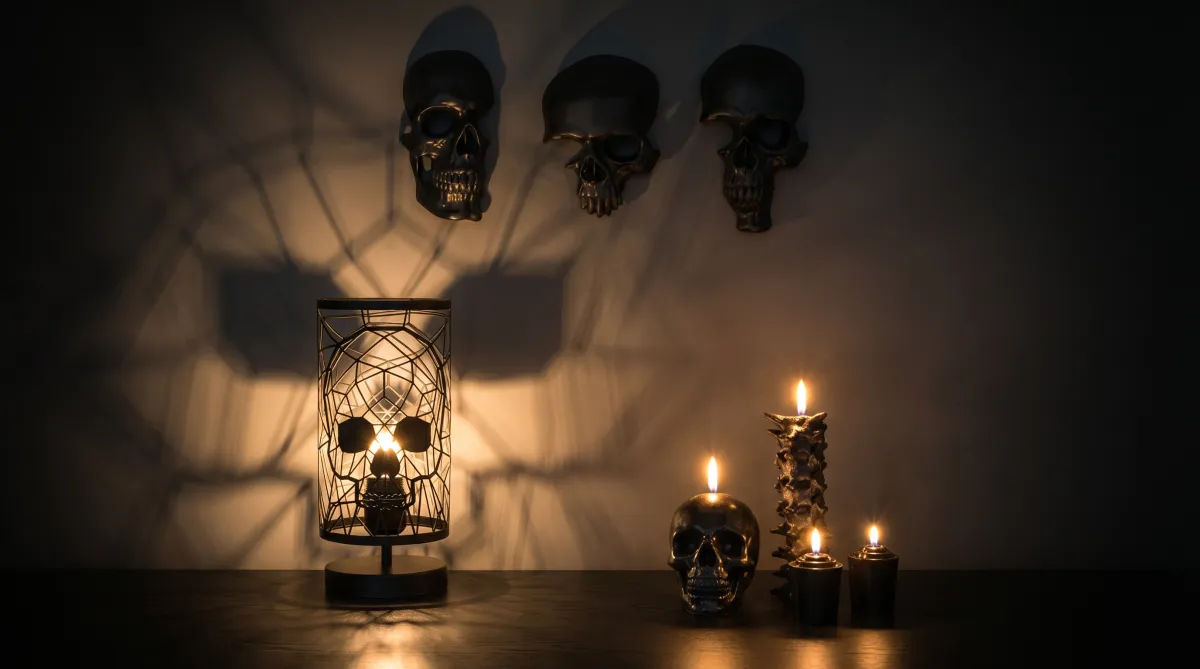
Their relationship with gothic objects is not theatrical. The MAVRA Skull Candle Set on their altar table is not there for effect. It is there because they light it on Tuesday evenings before reading. The objects serve daily life, not a seasonal performance.
The philosophy behind the object
The skull is one of the oldest symbols in human visual history. It appears in memento mori paintings, in Día de los Muertos altars, in alchemical illustrations, in Victorian jewelry. It carries weight precisely because it has been used seriously — not ironically, not playfully, but as a direct confrontation with mortality. That confrontation does not happen once a year. It is ongoing.
MAVRA uses the skull because we think it deserves to be taken seriously in home decor. Not softened. Not made cute. The people who buy our products chose the skull not because it is scary, but because it means something to them — permanence, acceptance, the weight of the real.
What Halloween Decor Actually Looks Like
The signatures of seasonal production
Halloween decor has specific signatures: bright orange, cartoon proportions, lightweight plastics, glow-in-the-dark finishes, and price points designed for one season of use. The skull in Halloween decor is a prop — simplified, exaggerated, designed to read from a distance at a party. It is not made to sit on a bookshelf year-round. It is not made to look like something someone actually chose.
It is made to be temporary, disposable, and replaced next year with something slightly different. This is not a criticism of Halloween. Halloween is its own thing, and there is an entire market of products designed to serve it. But it is not what MAVRA makes, and conflating the two does a disservice to both.
The craft gap between seasonal and permanent
Seasonal decor is engineered around a price point that justifies disposal. The material does not need to last three years because it was designed to last three months. The finish does not need to hold up under daily proximity because it will be stored after a few weeks. There is nothing wrong with this — it is the honest logic of a product category built around a calendar event.
MAVRA products are built under the opposite set of constraints. The MAVRA Skull Wall Decor uses a stone-finish resin that does not fade, does not chip the way painted surfaces do, and does not look cheap under natural daylight. Because daylight exists, and these pieces will be seen in it every day of the year.
Where the two markets diverge
The moment that separates Halloween decor from gothic decor is November 1st. Halloween decor goes into storage. Gothic decor stays. This single fact defines the entire design logic behind MAVRA — every decision about material, finish, and detail is made for the object that will remain. Not the object that will be packed away.
The person who buys our products is not buying for a holiday. They are buying for the life they have built — the aesthetic they have committed to, the space they have shaped over years.
What Separates MAVRA in Practice
The candle set: function that matches the aesthetic
Our Skull Candle Set is hand-poured. The wax blend, the wick placement, the burn time — these are details that matter when someone is going to light this candle on a Tuesday in January while reading or working or simply being home. It has to perform correctly, not just look dramatic in a photograph.
The vessel itself is designed to outlast the candle. When the wax is gone, the skull and spine form of the holder remains — a permanent object that did not disappear when the consumable was used up. The candle is the consumable. The holder is the decor. This is the logic of permanence applied at the product level.
The lamp: a functional light source first
Our Skull Lamp is a functional light source, not a display piece with a cord attached as an afterthought. The light quality, the socket compatibility, the base stability — all of it is considered because this is going to be on someone's nightstand or desk every night. It needs to produce the right light for reading. It needs to not wobble.
The warm amber globe bulb produces 1800K light — the same warm temperature as candlelight, which is exactly what gothic and dark-aesthetic rooms are built around. The lamp is not a decorative choice masquerading as a functional one. It is a functional choice that also happens to be aesthetically precise.
The wall decor: dimensional and daily
Our Skull Wall Decor mounts flush against the wall surface and produces a tight contact shadow that changes throughout the day as natural light shifts. This dimensional quality — the shadow, the depth, the way the piece reads differently in morning light than in candlelight — is only possible with an object built for permanence.
The stone-finish resin surface does not yellow, does not fade under indoor light, and does not look cheap under close inspection. These are properties of a material chosen because the piece will be on that wall for years. Halloween decor is not built to those specifications, because it does not need to be.
The Five Corrientes MAVRA Builds For
A product line that crosses aesthetic boundaries
Our customers do not share a single aesthetic. Some are drawn to Victorian Gothic — the heavy drapery, the carved wood, the candlelight as a philosophical choice. Some live in Trad Goth spaces — darker, harder, with no softening elements. Some prefer Whimsigoth — layered, maximalist, strange and intentional. Some are Southern Gothic — decay as beauty, rust as patina, weight as meaning. Some are Pastel Goth — the same symbols in lighter keys, the same darkness made soft.
Each of these aesthetics has a different relationship with our three products. The Skull Candle Set works differently in a Pastel Goth room than in a Trad Goth one. But it belongs in both. Because what these spaces share is not a visual style — it is a commitment to objects that mean something and are built to stay.
What separates a MAVRA buyer from a Halloween buyer
The MAVRA buyer has thought carefully about their space. They are not decorating impulsively. They know what they want, they know what they do not want, and they immediately recognize when something was made for them versus when something was made to look like it was made for them. They can identify the difference between a hand-poured candle and a mass-produced one at first glance.
They have been living this aesthetic for a while. Their home already has a direction. They are not assembling a mood board for October. They are looking for the specific thing that belongs in the specific place they have been saving for it — and they can tell, immediately, when they find it.
The refusal to be seasonal
MAVRA does not run October promotions. We do not position our products as holiday decor. We do not participate in Halloween marketing cycles. This is not a business oversight. It is a deliberate refusal to associate our products with the temporary, because our products are not temporary. The people who buy from us are not in a seasonal state of mind. They are building something permanent.
We take that seriously. It is why we do not cut corners on materials. It is why we spend time on the details that are only visible up close. It is why we are not interested in being in seasonal aisles.
This Is Not About One Night
The daily object versus the seasonal prop
When someone places a MAVRA candle set on their altar table, or puts a MAVRA skull lamp on their bedside shelf, or hangs a MAVRA wall piece above their desk — that is not a Halloween installation. That is a choice about what their permanent environment looks like. It will be there in January. It will be there in June. It will still be there next October, not because they brought it out of storage, but because it never left.
This is the fundamental difference between what MAVRA makes and what Halloween makes. One object is designed to be present for a night. The other is designed to be present for a life.
Gothic permanence in a disposable world
Victorian Gothic objects were designed to last. Stone-finish skull wall pieces, quality candle holders, brass and iron accents — these materials age beautifully rather than degrading badly. In a cultural moment defined by fast furniture and disposable decor, choosing objects built for permanence is itself a philosophical statement.
You are not decorating for the algorithm. You are not building a space for a single content moment. You are building a home for the long term — a space that reflects who you are every day of the year, and that gets better, not worse, with time.
The skull is not a Halloween prop in our hands. It is a design language — one that speaks to permanence, mortality, and the specific kind of beauty that only comes from taking darkness seriously.
MAVRA is gothic home decor for people who actually live the gothic aesthetic. Start with the MAVRA Skull Candle Set — the oldest of gothic rituals: the single flame that makes everything worth seeing visible.


Mail
Facebook
LinkedIn
X
Pinterest