

The MAVRA Pieces That Fit a Whimsigoth Space
What Makes a Piece Fit a Whimsigoth Space
Whimsigoth is not a compromise. It is not gothic that has been lightened up to make it more palatable, or cottage decor that has been darkened to add edge. It is its own thing — a maximalist layering of the strange and the beautiful, where dried botanical stems sit next to skull candleholders, where fairy-tale motifs and memento mori share the same shelf without either one canceling the other out.
The people who live in Whimsigoth spaces have specific taste. They know what belongs and what doesn't. They can identify immediately whether a piece was made for this aesthetic or whether it's just dark enough to pass.
MAVRA makes three products. Here is how each one fits — and why.
The Skull Candle Set in a Whimsigoth Room
Whimsigoth spaces tend to accumulate texture. There are surfaces covered in collected objects, in vessels and books and natural materials, in things that were found or chosen over years. The skull candle set functions differently than most other objects in that environment because it doesn't just sit there — it does something. It produces light, heat, movement, and scent. That makes it a more active presence than a static piece.
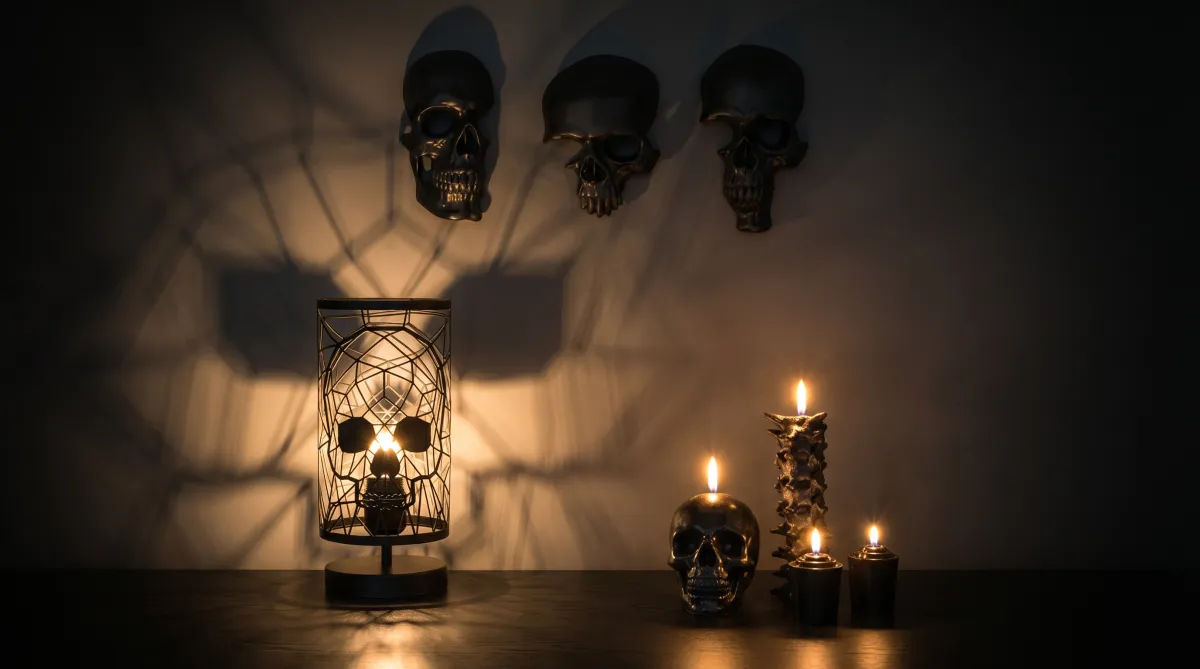
In a Whimsigoth setting, the CND candle set earns its place because the candlelight it produces is warm and close. It doesn't wash out the atmosphere of the room. It deepens it. The skulls in the set read as intentional rather than theatrical — they're not trying to be scary, and they don't look out of place among the crystals and the pressed flowers and the worn books. They have the same sense of weight that those things have.
The matte black wax, the hand-poured quality, the way the light catches the form of the skull — these are details that a Whimsigoth space rewards, because Whimsigoth is a style that notices details. People who decorate this way look closely. They see the difference between something that was made with care and something that was made to sell.
The Skull Lamp as a Whimsigoth Anchor
A Whimsigoth room usually has multiple layers of light — a main fixture, smaller lamps, candles, sometimes fairy lights woven through something. The skull lamp functions best as a mid-layer anchor: a single, deliberate light source that gives one corner or one shelf a defined center.
What makes the LMP lamp work in this context is the quality of the light it produces. The warm amber glow from the globe bulb is close and directional. It creates a lit zone and a dark zone, which is exactly what Whimsigoth spatial composition tends to do — draw the eye to specific areas rather than illuminating everything equally. A Whimsigoth room is designed to have shadows, and the lamp respects that.
The skull base also reads differently from a distance than it does up close. From across a maximalist room, it registers as a sculptural object with a warm glow. Up close, the detail in the form is visible — the hollows, the structure, the finish. Both readings work in a Whimsigoth space, which is rare for a functional piece.
In a maximalist room, the wrong piece disappears. The right one becomes the reason people notice the whole.
The Wall Decor in a Layered Space
Whimsigoth walls are typically busy. Botanical prints, mirrors, framed pressed flowers, shelves with small objects — there is usually a lot happening. The SWD skull wall decor works in this context because it has enough visual weight to hold its own without dominating, and because the stone-finish resin surface doesn't compete with the textures around it.
The key distinction is that the skull wall pieces don't look like accessories. They don't look like something bought to fill a gap. They look like something chosen deliberately, which is exactly the register Whimsigoth responds to. The aesthetic rewards the found, the collected, the specific — and these pieces carry that feeling even though they're manufactured objects.
The three-dimensional quality of the wall decor matters here too. In a flat gallery wall of prints and photographs, a dimensional piece changes the way the eye moves through the composition. It introduces depth into what would otherwise be a surface-level arrangement. Whimsigoth tends to welcome that kind of disruption.
What These Three Pieces Share
The CND candle set, the LMP lamp, and the SWD wall decor all share one characteristic that makes them work in a Whimsigoth space: they were made to be looked at closely.
Whimsigoth is a style defined by accumulation and attention to detail. It rewards objects that reveal more the more you look at them. All three MAVRA pieces do that — the texture of the wax, the curve of the skull base, the depth of the stone-finish resin surface. They hold up to proximity, which is something maximalist spaces demand of every object they contain.
They also share a color range that fits naturally. The black, charcoal, and dark warm tones of MAVRA products work with the earthy, moody palette that Whimsigoth tends to favor — forest greens, deep burgundies, aged wood, dried botanicals. Nothing in the line reads as harsh or cold, which would break the warmth that Whimsigoth spaces usually maintain.
If you're building a Whimsigoth room — or refining one — these pieces don't require you to reorganize your aesthetic around them. They fit into what you're already building, and they stay.


Mail
Facebook
LinkedIn
X
Pinterest