
Transforming a Room into a Pastel Goth Space: What It Actually Takes
Why the Work Is in the Contrast, Not the Softness
Pastel Goth is one of the most misread aesthetics in home decor. People see the soft lavender walls and the blush upholstery and assume the work is in the softness. It isn't. The work is in the contrast — in finding the specific gothic elements that make the softness legible as Pastel Goth rather than just pale and pretty.
Without the dark anchors, a Pastel Goth room is just a pastel room. The skulls, the heavy forms, the dimensional gothic objects — these are not accessories to the aesthetic. They are what makes it coherent.
Here is what a real Pastel Goth transformation looks like, and where the decisions actually get made.
Start With the Wall, Not the Accessories
The first mistake people make when building a Pastel Goth space is buying the soft elements first — the dusty rose throw, the lilac velvet chair — and then trying to find gothic pieces that fit. This works in reverse. The muted palette is easy to source. The gothic elements with enough visual weight to hold their own against it are harder.
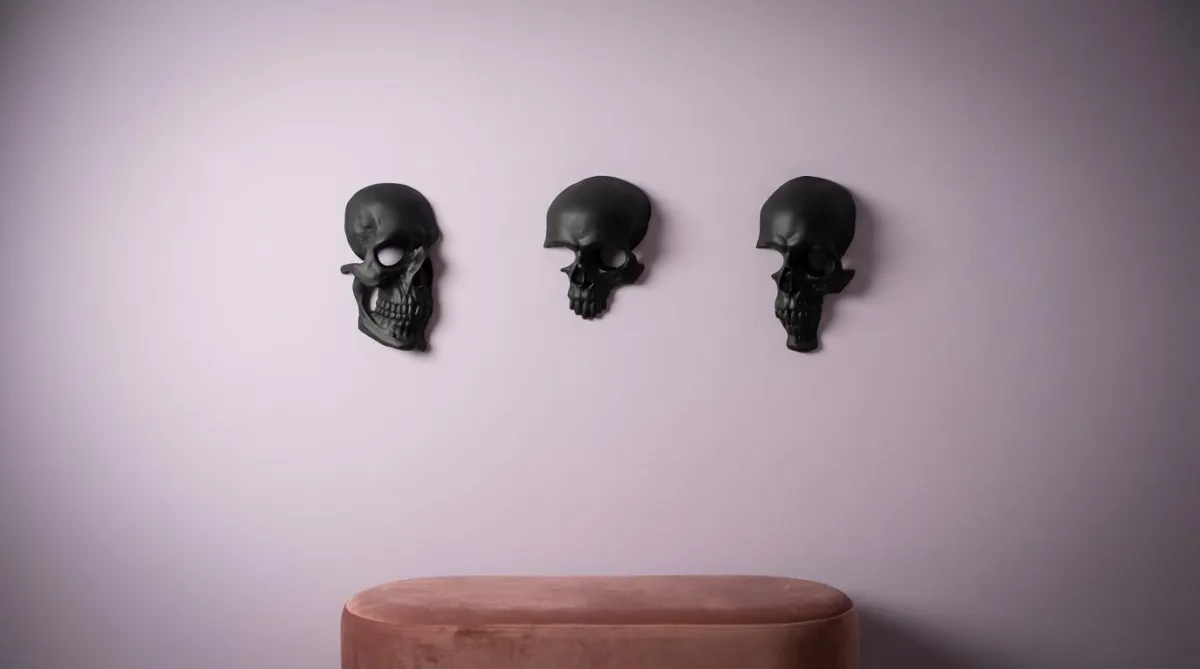
The right starting point is the wall. A pale matte wall — lavender, sage, or dusty grey — gives the dark pieces something to press against. The contrast between a stone-finish skull and a soft pale wall is what creates the Pastel Goth visual tension that defines the aesthetic. You are building toward that moment, not away from it.
Once the wall is established, the soft furnishings follow naturally. They do not define the space. They support the contrast.
The Role of Dark Anchors
Every Pastel Goth room needs at least one object that reads as unambiguously gothic — heavy, dimensional, and dark enough to register clearly against the soft background. Without this, the room reads as pastel with gothic suggestions rather than Pastel Goth.
This is where the Skull Wall Decor does specific work. Mounted flat against a pale wall, the dark stone-finish resin surface creates immediate contrast. The dimensional form of the skull pieces produces shadows that the flat wall cannot — they cast depth into what would otherwise be a soft, even surface. The result is a composition that has a center of gravity, something the eye returns to.
The key is placement. The wall decor should be installed at eye level on the main wall — not scattered across multiple surfaces, not placed above a door as an afterthought. A Pastel Goth room is not maximalist. It earns its atmosphere through restraint and specificity, and the dark anchor piece should be given room to operate.
The softness only works when something refuses to be soft.
Light as a Transformation Tool
Pastel Goth rooms tend to play with light differently than other gothic spaces. The goal is not total darkness — it's layered light that picks out specific elements and lets others fall into a soft background glow.
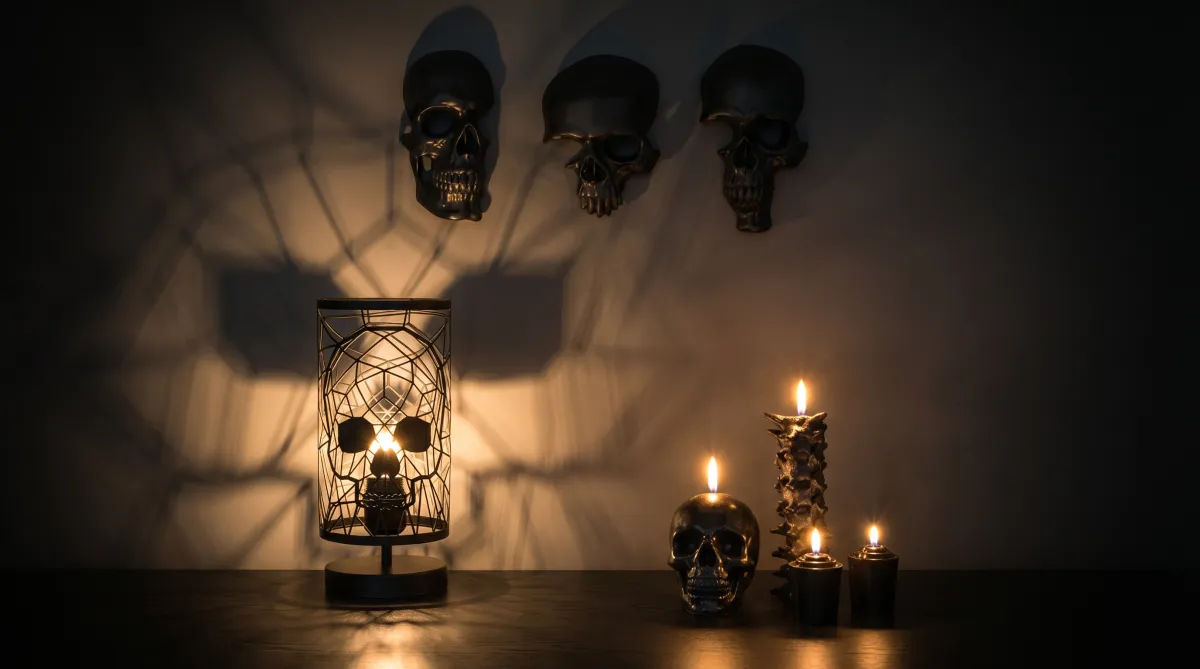
The Skull Lamp is effective in this context because its light is contained. The warm amber from the globe bulb creates a defined pool of warmth, which reads differently against a pale lavender wall than it would against a dark charcoal surface. The lamp becomes both a light source and a visual object — the skull form visible in the warm glow, the pale wall picking up the color of the light behind it.
A Pastel Goth room with a skull lamp in one corner, a pale wall, and dusty rose textiles is already coherent. You do not need much. The specific choices matter more than the number of them.
The Candle Set as Ritual Object
The Skull Candle Set functions differently in a Pastel Goth room than in a darker gothic space. In a Victorian Gothic or Trad Goth room, the candles deepen an already dark atmosphere. In a Pastel Goth room, they introduce it.
Placed on a pale marble surface or a light wood nightstand, the matte black wax of the candle set creates a focal contrast point. When lit, the warm amber flame against a soft background gives the room a quality that soft furnishings alone cannot — a sense that the space is inhabited by someone who has thought carefully about it, not someone who has assembled it from a mood board.
The hand-poured quality also matters here. Pastel Goth is not a mass-market aesthetic. The people who live in these spaces are typically sourcing carefully, buying specifically. A candle set that looks like it came from a seasonal aisle reads wrong. One that shows the texture of the wax and the care of the pour reads right.
What the Room Feels Like When It's Done
A finished Pastel Goth room does not feel contradictory. The soft and the dark have resolved into something unified — a space that is clearly gothic in sensibility and clearly gentle in palette. The two qualities reinforce rather than cancel each other.
The transformation is complete when you can look at the space and understand that every element was chosen. The pale wall. The dark skull pieces. The warm light in the corner. The soft textiles that absorb and soften the ambient light. Nothing in the room is accidental, and nothing in the room is competing.
That specificity is what Pastel Goth is. It is not a compromise between two aesthetics. It is a precisely calibrated space where softness and gothic weight coexist because someone understood how to arrange them. MAVRA pieces, used correctly, are part of that arrangement.


Mail
Facebook
LinkedIn
X
Pinterest