
Victorian Gothic Decor: How Your Home Reveals the Darkest Side of Your Personality
The Victorian Darkness That Never Left
Mourning culture as an aesthetic philosophy
Victorian England developed an elaborate language of death that we are still speaking today. The Victorians built entire rooms around grief — mourning parlors draped in black crepe, mantelpieces crowded with memento mori objects, candlelight that turned ordinary evenings into rituals of contemplation. What we call Victorian Gothic decor is not nostalgia. It is the survival of a philosophy that took darkness seriously.
The person drawn to Victorian Gothic understands something that modern minimalism tries to forget: that beauty without shadow is incomplete. Your home, if you inhabit it honestly, will show this understanding in every surface.
What your decor instincts reveal about you
Victorian Gothic is not chosen randomly. People who gravitate toward heavy drapery, candlelight, and skull iconography share a particular relationship with time and mortality. Research in environmental psychology consistently shows that our aesthetic choices externalize our inner architecture — the home becomes a self-portrait drawn in furniture and light.
If Victorian Gothic speaks to you, your home is likely to prize depth over minimalism, ritual over convenience, and permanent beauty over seasonal trends. These are not decorating preferences. They are personality signatures.
The three pillars of Victorian Gothic aesthetic identity
Every authentic Victorian Gothic space rests on three foundations: symbolic objects that carry cultural weight, controlled darkness that uses shadow as a design element, and material permanence — surfaces and objects that feel as if they have always existed and always will.
How Victorian Gothic Translates to Modern Living Spaces
The bedroom as a mourning parlor reborn
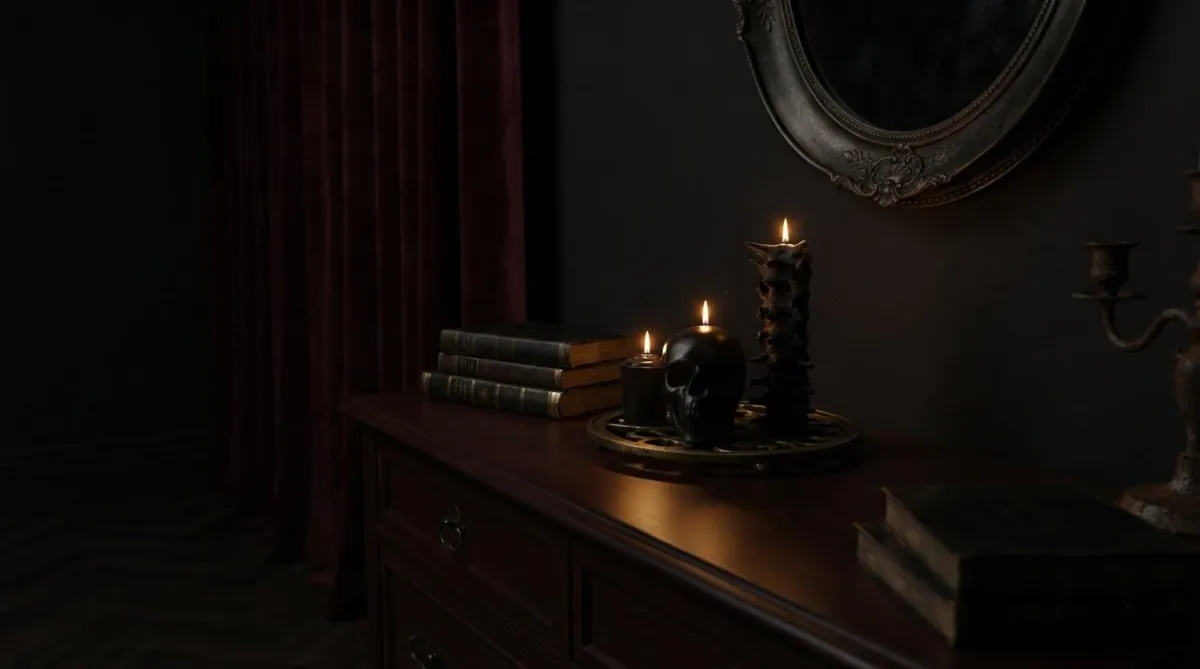
The Victorian bedroom was the most private room in the house and therefore the most honest. In a modern Victorian Gothic bedroom, this logic translates into layered textiles, controlled light sources, and objects on the nightstand that carry personal symbolic weight. The MAVRA Skull Candle Set, placed on a dark wood nightstand, recreates the Victorian tradition of the single candle as a meditation on time.
Living rooms and the art of the gothic focal point
Victorian parlors were designed around focal points — the fireplace, the portrait, the curio cabinet. Modern Victorian Gothic living rooms work the same way: one commanding dark element around which everything else orbits. Without a focal point, Victorian Gothic becomes clutter. With one, it becomes atmosphere.
Transitional spaces and the corridor of intention
Hallways and entryways were treated with great seriousness in Victorian homes. A single gothic element placed in a transitional space signals that the darkness you have chosen is intentional and total, not limited to one room.
The Color Language of Victorian Gothic Spaces
Working with deep jewel tones and near-black walls
Victorian interior color was not afraid of depth. Deep burgundy, forest green, and near-black charcoal walls functioned as backdrops that made objects glow. Dark walls are not oppressive — they are focusing. They eliminate the ambient distraction of bright white surfaces and force the eye toward the objects you have deliberately chosen.
The role of warm candlelight in Victorian Gothic interiors
Victorian rooms were never truly dark. They were selectively illuminated — pools of warm amber light surrounded by deep shadow. This chiaroscuro was not an accident of primitive lighting but a deliberate aesthetic choice that created drama, intimacy, and a sense of occasion even in ordinary moments.
The MAVRA Skull Candle Set recreates this Victorian chiaroscuro precisely: warm 1800K amber flame light that illuminates only what it immediately touches, allowing the periphery of the room to remain in atmospheric darkness.
Metallic accents and the patina of time
Victorian Gothic interiors used oxidized brass, aged pewter, and blackened iron as accent materials — metals that showed evidence of age and use. In contemporary Gothic spaces, these finishes translate easily: matte black fixtures, aged iron side tables, and objects that carry the visual signature of permanence rather than novelty.
Victorian Gothic Personality Traits and Their Spatial Expressions
The contemplative introvert and their need for ritual spaces
Victorian Gothic decor is almost universally chosen by people who value solitude and ritual. The person who lights candles before settling in to read, who arranges objects on a shelf with care, who prefers one beautiful object over five mediocre ones — this person is creating a Victorian Gothic space whether they use the term or not.
The collector and the cabinet of curiosities
Victorian parlors often featured cabinets of curiosities — collections of objects that told stories and prompted questions. The modern Victorian Gothic collector organizes with the same impulse: objects are gathered not for decoration but for what they say about mortality, beauty, and the passage of time. A skull candle set beside antique books beside a single preserved flower is not clutter — it is curation.
The aesthete who refuses compromise
Perhaps the most consistent trait of the Victorian Gothic personality is an absolute refusal to compromise on beauty. The authentic Victorian Gothic person will not add a bright accent piece to lighten things up, will not remove the heavy drapery because guests find it dramatic, and will not apologize for the skull on their nightstand.
Building Your Victorian Gothic Space From the Ground Up
Starting with darkness: the foundational layer
Begin with your walls. A deep, near-black charcoal or forest green creates the backdrop that every subsequent element needs to function correctly. Without a dark ground, Victorian Gothic objects float in visual noise. With it, even a single lit candle becomes a painting.
The anchor object: choosing your primary Gothic statement
Every Victorian Gothic room needs one primary anchor. The MAVRA Skull Wall Decor three-piece set functions perfectly as a bedroom or living room anchor — mounted above the headboard, it creates the kind of wall focal point that Victorian parlors built entire room arrangements around.
Layering in secondary elements without creating clutter
Once your anchor is placed, secondary elements should relate to it thematically and spatially. A candle set on the nightstand below a skull lamp. A wall piece above the surface where your candles burn. Each additional object should either repeat the primary theme or create a visual conversation with the anchor, never compete with it for dominance.
The Emotional Architecture of Victorian Gothic Living
Why darkness feels like home to certain people
Environmental psychologists note that people who feel uncomfortable in bright, minimalist spaces are not simply being difficult — they are responding to real physiological and psychological differences in how they process stimulation and find rest. For many people, the warm, dim, heavy atmosphere of a Victorian Gothic interior is genuinely calming in a way that bright contemporary interiors are not.
Ritual and the repeated gesture in Gothic living
One of the least-discussed aspects of Victorian Gothic living is its emphasis on daily ritual. The act of lighting candles before settling in, of arranging objects carefully, of maintaining a space that requires attention and intention — these micro-rituals create a relationship between person and space that purely functional interiors never achieve.
Gothic permanence in a disposable world
Victorian Gothic objects are designed to last. Stone-finish skull wall pieces, brass and iron candle holders, quality fabric — these materials age beautifully rather than degrading badly. In a cultural moment defined by fast furniture and disposable decor, choosing objects built for permanence is itself a philosophical statement.
Your Victorian Gothic Space Is a Self-Portrait
Reading a room as reading a person
The Victorian Gothic interior makes your personality visible. The objects you choose, the way you light your space, the commitment you make to darkness over brightness — these are not aesthetic decisions. They are self-disclosures. The person who enters a well-built Victorian Gothic room understands something real about its inhabitant without a word being spoken.
Building toward completeness
A Victorian Gothic space is never finished — it evolves as its inhabitant does. The first candle set becomes the anchor for a lamp. The lamp reveals the need for a wall piece above it. This evolution is not indecision. It is the natural growth of a space that is genuinely alive.
The Victorian understood that home is not where you sleep. It is where you reveal yourself most completely.
Ready to build your Victorian Gothic sanctuary? The MAVRA Skull Candle Set begins with the oldest of Victorian dark rituals — the single flame that makes everything worth seeing visible.



Mail
Facebook
LinkedIn
X
Pinterest